 |
OpenMS
|
Estimates posterior error probabilities (PEPs) of peptide-spectrum matches from search engine scores. More...
#include <OpenMS/MATH/STATISTICS/PosteriorErrorProbabilityModel.h>
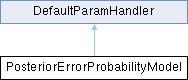
Public Types | |
| enum class | ModelType { NONE , MIXTURE , TARGET_DECOY_ISOTONIC } |
| The kind of model that was estimated by the last call to one of the fit functions. More... | |
Public Member Functions | |
| PosteriorErrorProbabilityModel () | |
| default constructor | |
| ~PosteriorErrorProbabilityModel () override | |
| Destructor. | |
| bool | fit (std::vector< double > &search_engine_scores, const std::string &outlier_handling) |
| fits the distributions to the data points(search_engine_scores). Estimated parameters for the distributions are saved in member variables. computeProbability can be used afterwards. | |
| bool | fitGumbelGauss (std::vector< double > &search_engine_scores, const std::string &outlier_handling) |
fits the distributions to the data points(search_engine_scores). Estimated parameters for the distributions are saved in member variables. computeProbability can be used afterwards. Uses Gumbel+Gauss (independent of the parameter incorrectly_assigned). Fits the Gumbel distribution by maximizing the (weighted) likelihood. | |
| bool | fit (std::vector< double > &search_engine_scores, std::vector< double > &probabilities, const std::string &outlier_handling) |
| fits the distributions to the data points(search_engine_scores) and writes the computed probabilities into the given vector (the second one). | |
| bool | fitTargetDecoy (const std::vector< double > &target_scores, const std::vector< double > &decoy_scores, const std::string &outlier_handling) |
| estimates the PEP model from scores of target and decoy PSMs. computeProbability() (targets) and computeDecoyProbability() (decoys) can be used afterwards. | |
| ModelType | getModelType () const |
| returns the kind of model estimated by the last fit | |
| double | getTargetDecoyIncorrectFraction () const |
| returns the target-decoy estimate of the fraction of incorrect target PSMs, i.e. (number of decoys) / (number of targets) / decoy_ratio (capped at 1), as computed by the last call to fitTargetDecoy(). Returns -1 if it is not available (also if the last fit failed). | |
| bool | hasCalibrationWarning () const |
| returns true if the last call to fitTargetDecoy() found the target-decoy assumptions to be violated at low scores | |
| double | getTargetDecoyAUC () const |
returns the area under the ROC curve for separating target from decoy PSMs by score (ties count half), as computed by the last call to fitTargetDecoy(), or -1 if it is not available (no decoys, decoy_handling = ignore, or the last fit failed). | |
| std::vector< std::pair< double, double > > | getIsotonicPEPCurve () const |
| returns the PEP curve of the non-parametric target-decoy estimate as pairs (score, PEP), sorted by score. | |
| void | fillDensities (const std::vector< double > &x_scores, std::vector< double > &incorrect_density, std::vector< double > &correct_density) |
| Writes the distributions densities into the two vectors for a set of scores. Incorrect_densities represent the incorrectly assigned sequences. | |
| void | fillLogDensities (const std::vector< double > &x_scores, std::vector< double > &incorrect_density, std::vector< double > &correct_density) |
| Writes the log distributions densities into the two vectors for a set of scores. Incorrect_densities represent the incorrectly assigned sequences. | |
| void | fillLogDensitiesGumbel (const std::vector< double > &x_scores, std::vector< double > &incorrect_density, std::vector< double > &correct_density) |
| Writes the log distributions of gumbel and gauss densities into the two vectors for a set of scores. Incorrect_densities represent the incorrectly assigned sequences. | |
| double | computeLogLikelihood (const std::vector< double > &incorrect_density, const std::vector< double > &correct_density) const |
| computes the Likelihood with a log-likelihood function. | |
| double | computeLLAndIncorrectPosteriorsFromLogDensities (const std::vector< double > &incorrect_log_density, const std::vector< double > &correct_log_density, std::vector< double > &incorrect_posterior) const |
| std::pair< double, double > | pos_neg_mean_weighted_posteriors (const std::vector< double > &x_scores, const std::vector< double > &incorrect_posteriors) |
| std::pair< double, double > | pos_neg_sigma_weighted_posteriors (const std::vector< double > &x_scores, const std::vector< double > &incorrect_posteriors, const std::pair< double, double > &pos_neg_mean) |
| GaussFitter::GaussFitResult | getCorrectlyAssignedFitResult () const |
| returns estimated parameters for correctly assigned sequences. Fit should be used before. | |
| GaussFitter::GaussFitResult | getIncorrectlyAssignedFitResult () const |
| returns estimated parameters for incorrectly assigned sequences (for the Gumbel distribution, x0 and sigma are the location and scale parameter). Fit should be used before. | |
| GumbelMaxLikelihoodFitter::GumbelDistributionFitResult | getIncorrectlyAssignedGumbelFitResult () const |
| returns estimated Gumbel parameters for incorrectly assigned sequences. Fit should be used before. | |
| double | getNegativePrior () const |
| returns the estimated negative prior probability. | |
| double | computeProbability (double score) const |
| double | computeDecoyProbability (double score) const |
| returns the posterior error probability of a decoy PSM with the given score | |
| TextFile | initPlots (std::vector< double > &x_scores) |
| initializes the plots | |
| const std::string | getGumbelGnuplotFormula (const GaussFitter::GaussFitResult ¶ms) const |
| returns the gnuplot formula of the fitted gumbel distribution. Only x0 and sigma are used as local parameter alpha and scale parameter beta, respectively. | |
| const std::string | getGaussGnuplotFormula (const GaussFitter::GaussFitResult ¶ms) const |
| returns the gnuplot formula of the fitted gauss distribution. | |
| const std::string | getBothGnuplotFormula (const GaussFitter::GaussFitResult &incorrect, const GaussFitter::GaussFitResult &correct) const |
| returns the gnuplot formula of the fitted mixture distribution. | |
| void | plotTargetDecoyEstimation (std::vector< double > &target, std::vector< double > &decoy) |
| plots the score distributions of target and decoy PSMs together with the estimated model | |
| double | getSmallestScore () const |
| returns the smallest score used in the last fit | |
| void | tryGnuplot (const std::string &gp_file) |
| try to invoke 'gnuplot' on the file to create PDF automatically | |
 Public Member Functions inherited from DefaultParamHandler | |
| DefaultParamHandler (const std::string &name) | |
| Constructor with name that is displayed in error messages. | |
| DefaultParamHandler (const DefaultParamHandler &rhs) | |
| Copy constructor. | |
| virtual | ~DefaultParamHandler () |
| Destructor. | |
| DefaultParamHandler & | operator= (const DefaultParamHandler &rhs) |
| Assignment operator. | |
| virtual bool | operator== (const DefaultParamHandler &rhs) const |
| Equality operator. | |
| void | setParameters (const Param ¶m) |
| Sets the parameters. | |
| const Param & | getParameters () const |
| Non-mutable access to the parameters. | |
| const Param & | getDefaults () const |
| Non-mutable access to the default parameters. | |
| const std::string & | getName () const |
| Non-mutable access to the name. | |
| void | setName (const std::string &name) |
| Mutable access to the name. | |
| const std::vector< std::string > & | getSubsections () const |
| Non-mutable access to the registered subsections. | |
Static Public Member Functions | |
| static std::string | modelTypeToString (ModelType type) |
| human-readable name of a ModelType | |
| static std::map< std::string, std::vector< std::vector< double > > > | extractAndTransformScores (const std::vector< ProteinIdentification > &protein_ids, const PeptideIdentificationList &peptide_ids, const bool split_charge, const bool top_hits_only, const bool peptide_level=false) |
| extract and transform score types to a range and score orientation that the PEP model can handle | |
| static std::map< std::string, std::vector< std::vector< double > > > | extractAndTransformScores (const std::vector< ProteinIdentification > &protein_ids, const PeptideIdentificationList &peptide_ids, const bool split_charge, const bool top_hits_only, const bool target_decoy_available, const double fdr_for_targets_smaller) |
| extract and transform score types to a range and score orientation that the PEP model can handle | |
| static void | updateScores (const PosteriorErrorProbabilityModel &PEP_model, const std::string &search_engine, const Int charge, const bool prob_correct, const bool split_charge, std::vector< ProteinIdentification > &protein_ids, PeptideIdentificationList &peptide_ids, bool &unable_to_fit_data, bool &data_might_not_be_well_fit) |
| update score entries with PEP (or 1-PEP) estimates | |
| static void | updateScores (const PosteriorErrorProbabilityModel &PEP_model, const std::string &search_engine, const Int charge, const bool prob_correct, const bool split_charge, std::vector< ProteinIdentification > &protein_ids, PeptideIdentificationList &peptide_ids, bool &unable_to_fit_data, bool &data_might_not_be_well_fit, std::set< std::pair< Size, Size > > &updated_hits) |
| update score entries with PEP (or 1-PEP) estimates and report which hits were updated | |
| static std::string | getSearchEngineKey (const ProteinIdentification &protein_id) |
| the key under which the scores of a search run are reported by extractAndTransformScores() | |
| static double | getGumbel_ (double x, const GaussFitter::GaussFitResult ¶ms) |
| computes the gumbel density at position x with parameters params. | |
| Static Public Member Functions inherited from DefaultParamHandler | |
| static void | writeParametersToMetaValues (const Param &write_this, MetaInfoInterface &write_here, const std::string &key_prefix="") |
| Writes all parameters to meta values. | |
Private Member Functions | |
| void | resetFit_ () |
| resets the state of the last fit (model type, target-decoy diagnostics, non-parametric curve) | |
| void | processOutliers_ (std::vector< double > &x_scores, const std::string &outlier_handling) const |
| remove (or clamp) outliers for fitting | |
| bool | fitMixture_ (std::vector< double > scores, bool use_gumbel, const std::string &outlier_handling) |
| fits a two-component mixture model with the EM algorithm | |
| bool | fitTargetDecoyModel_ (const std::vector< double > &targets, const std::vector< double > &decoys, const std::string &outlier_handling) |
| fits the target-decoy model (or, without decoys or with decoy_handling 'ignore', the mixture model) to finite target and decoy scores | |
| bool | fitIsotonic_ (const std::vector< double > &target_scores, const std::vector< double > &decoy_scores) |
| estimates the non-parametric target-decoy model; returns false if it cannot be estimated | |
| double | logIncorrectDensity_ (double x) const |
log density of the incorrect component at x (in the shifted score space) | |
| double | logCorrectDensity_ (double x) const |
log density of the correct component at x (in the shifted score space) | |
| double | incorrectMode_ () const |
| mode of the incorrect component (in the shifted score space) | |
| PosteriorErrorProbabilityModel & | operator= (const PosteriorErrorProbabilityModel &rhs) |
| assignment operator (not implemented) | |
| PosteriorErrorProbabilityModel (const PosteriorErrorProbabilityModel &rhs) | |
| Copy constructor (not implemented) | |
Static Private Member Functions | |
| static double | transformScore_ (const std::string &engine, const PeptideHit &hit, const std::string ¤t_score_type, bool higher_score_better, const std::string &score_source) |
| static void | updateScores_ (const PosteriorErrorProbabilityModel &PEP_model, const std::string &search_engine, const Int charge, const bool prob_correct, const bool split_charge, std::vector< ProteinIdentification > &protein_ids, PeptideIdentificationList &peptide_ids, bool &unable_to_fit_data, bool &data_might_not_be_well_fit, bool unusable_to_one, std::set< std::pair< Size, Size > > &updated_hits) |
implementation of updateScores(); hits without a usable score get a PEP of 1 if unusable_to_one is set, otherwise they are left unchanged | |
| static std::map< std::string, std::string > | chooseScoreSources_ (const std::map< std::string, std::string > &run_to_engine, const PeptideIdentificationList &peptide_ids) |
| static bool | getScore_ (const std::vector< std::string > &requested_score_types, const PeptideHit &hit, const std::string &actual_score_type, double &value) |
Private Attributes | |
| GaussFitter::GaussFitResult | incorrectly_assigned_fit_param_ |
| stores parameters for incorrectly assigned sequences. If gumbel fit was used, A can be ignored. Furthermore, in this case, x0 and sigma are the local parameter alpha and scale parameter beta, respectively. | |
| GumbelMaxLikelihoodFitter::GumbelDistributionFitResult | incorrectly_assigned_fit_gumbel_param_ |
| GaussFitter::GaussFitResult | correctly_assigned_fit_param_ |
| stores gauss parameters | |
| double | negative_prior_ |
| stores final prior probability for negative peptides | |
| double | smallest_score_ |
| smallest score which was used for fitting the model | |
| const std::string(PosteriorErrorProbabilityModel::* | getNegativeGnuplotFormula_ )(const GaussFitter::GaussFitResult ¶ms) const |
| points either to getGumbelGnuplotFormula or getGaussGnuplotFormula depending on whether one uses the gumbel or the gaussian distribution for incorrectly assigned sequences. | |
| const std::string(PosteriorErrorProbabilityModel::* | getPositiveGnuplotFormula_ )(const GaussFitter::GaussFitResult ¶ms) const |
| points to getGumbelGnuplotFormula | |
| ModelType | model_type_ |
| kind of the last estimated model | |
| bool | incorrect_is_gumbel_ |
| whether the incorrect component of the (last) mixture model is a Gumbel distribution (otherwise Gauss) | |
| std::vector< double > | isotonic_scores_ |
| knots of the non-parametric PEP curve: scores (ascending) and PEPs (non-increasing) | |
| std::vector< double > | isotonic_peps_ |
| std::vector< double > | decoy_scores_ |
| knots of the PEP curve of decoys (label-swapped estimates at the scores of the fitted decoys): scores (ascending) and PEPs (non-increasing) | |
| std::vector< double > | decoy_peps_ |
| double | td_incorrect_fraction_ |
| target-decoy estimate of the fraction of incorrect targets (-1 if not available) | |
| double | td_auc_ |
| area under the ROC curve of targets vs. decoys of the last target-decoy fit (-1 if not available) | |
| bool | calibration_warning_ |
| whether the last target-decoy fit found too few decoys among the lowest-scoring PSMs (see hasCalibrationWarning()) | |
Additional Inherited Members | |
| Protected Member Functions inherited from DefaultParamHandler | |
| virtual void | updateMembers_ () |
| This method is used to update extra member variables at the end of the setParameters() method. | |
| void | defaultsToParam_ () |
| Updates the parameters after the defaults have been set in the constructor. | |
| Protected Attributes inherited from DefaultParamHandler | |
| Param | param_ |
| Container for current parameters. | |
| Param | defaults_ |
| Container for default parameters. This member should be filled in the constructor of derived classes! | |
| std::vector< std::string > | subsections_ |
| Container for registered subsections. This member should be filled in the constructor of derived classes! | |
| std::string | error_name_ |
| Name that is displayed in error messages during the parameter checking. | |
| bool | check_defaults_ |
| If this member is set to false no checking if parameters in done;. | |
| bool | warn_empty_defaults_ |
| If this member is set to false no warning is emitted when defaults are empty;. | |
Estimates posterior error probabilities (PEPs) of peptide-spectrum matches from search engine scores.
Two estimators are available:
decoy_handling = ignore, where targets and decoys are pooled): a two-component mixture of a Gumbel (or Gauss) distribution for incorrect and a Gauss distribution for correct assignments is fitted to all scores with the EM algorithm. The very same densities are used for fitting and for computing probabilities. The Gumbel component is fitted by weighted maximum likelihood.decoy_handling = auto, the default): Under target-decoy competition (concatenated target+decoy search, top hit per spectrum), each decoy winner stands in for (about) one incorrect target winner. The probability p(s) that a PSM with score s is a decoy is estimated by weighted isotonic regression (pool-adjacent-violators, tied scores pooled) and the PEP of a target PSM is PEP(s) = p(s) / (1 - p(s)) / decoy_ratio (cf. Percolator/qvality, Käll et al. 2008). The blocks and their PEPs only depend on the ordering of the scores, so they are invariant to monotone score transformations (e-values, p-values, raw scores, discrete or censored scores). Block decoy fractions are shrunk with a Jeffreys prior, and the PEPs of the targets scoring above all decoys sum up to 1 / decoy_ratio (the expected number of incorrect targets above the best decoy), so that no PEP is exactly 0. Even a single decoy (or a single target) is informative. Within a block, the PEP decreases linearly with the score around the block's PEP (keeping the mean PEP of the block), such that PSMs are ordered by score; between blocks, the PEP is interpolated linearly. These ramps use the score values, i.e. they (but not the block PEPs) depend on the score scale. As in qvality, Percolator and mokapot, the PEP is not forced to 1 at the lowest scores, where it follows the local ratio of decoys and targets (see hasCalibrationWarning()). Decoys get their PEPs from a symmetric (label-swapped) estimate, see computeDecoyProbability(): the curve is fitted with the decoy labels, which makes it more favorable for targets than for decoys at the same score. Without the label swap, an incorrect target can score above the best decoy and get a low PEP, but a decoy never can. Downstream target-decoy FDR estimates on the PEPs (e.g. protein FDR after protein inference across many small runs) would then miss these incorrect targets.min_mixture_scores scores (default 35, as PeptideProphet; also counted after outlier handling), the mixture model is not fitted at all.One can output the fit as a gnuplot formula using getGumbelGnuplotFormula() and getGaussGnuplotFormula() after fitting.
| Name | Type | Default | Restrictions | Description |
|---|---|---|---|---|
| out_plot | string | If given, the some output files will be saved in the following manner: |
||
| number_of_bins | int | 100 | Number of bins used for visualization. Only needed if each iteration step of the EM-Algorithm will be visualized | |
| incorrectly_assigned | string | Gumbel | Gumbel, Gauss | Distribution of the scores of incorrectly assigned sequences in the mixture model. For 'Gumbel', the Gumbel distribution is used (fitted by maximum likelihood). For 'Gauss', the Gauss distribution is used. |
| max_nr_iterations | int | 1000 | Bounds the number of iterations for the EM algorithm when convergence is slow. | |
| neg_log_delta | int | 6 | The negative logarithm of the convergence threshold for the likelihood increase. | |
| outlier_handling | string | ignore_iqr_outliers | ignore_iqr_outliers, set_iqr_to_closest_valid, ignore_extreme_percentiles, none | What to do with outliers (mixture model only): - ignore_iqr_outliers: ignore outliers outside of 3*IQR from Q1/Q3 for fitting - set_iqr_to_closest_valid: set IQR-based outliers to the last valid value for fitting - ignore_extreme_percentiles: ignore everything outside 99.9th and 1st percentile (also removes equal values like potential censored max values in XTandem) - none: do nothing |
| decoy_handling | string | auto | auto, ignore | How target/decoy annotations are used: - auto: if decoy PSMs are present (even a single one), non-parametric target-decoy estimate from the local ratio of decoys and targets (isotonic regression); its blocks depend only on the order of the scores, i.e. it is suitable for any score type. Without decoys, mixture model of the target scores. - ignore: ignore the annotations, i.e. targets and decoys are pooled and modeled without supervision (behavior of OpenMS 3.5 and earlier) The target-decoy estimate assumes a search against a concatenated target+decoy database (target-decoy competition). Only top hits are used for fitting. |
| decoy_ratio | float | 1.0 | min: 1.0e-06 | Number of decoy sequences per target sequence in the searched database (cf. DecoyDatabase's 'shuffle_decoy_ratio'). Under target-decoy competition, the number of incorrect targets is estimated as the number of decoys divided by this ratio. |
| min_decoys | int | 10 | min: 1 | Only used by IDPosteriorErrorProbability with 'split_charge': charge states with fewer decoy PSMs use the target-decoy data of all charge states (1: separate models for all charge states with decoys). |
| min_mixture_scores | int | 35 | min: 2 | Minimum number of (finite) scores to fit the mixture model (used without decoys, or with decoy_handling 'ignore'), before and after outlier handling. With fewer scores, no model is fitted: the scores of so few PSMs without decoys do not determine the two components (PeptideProphet also requires 35 PSMs per model). IDPosteriorErrorProbability with 'split_charge' then uses the mixture model of all charge states. |
|
strong |
The kind of model that was estimated by the last call to one of the fit functions.
default constructor
|
override |
Destructor.
|
private |
Copy constructor (not implemented)
|
staticprivate |
For each engine (key) of run_to_engine (run identifier -> engine key): the score type to use for all of its hits. For engines with dedicated support, the most preferred of their score types that any hit has; otherwise (or if no hit has any of them) an empty string, i.e. the main score of the identifications. One score type per engine keeps the scores of a model on the same scale.
| double computeDecoyProbability | ( | double | score | ) | const |
returns the posterior error probability of a decoy PSM with the given score
For the non-parametric target-decoy estimate, the PEP of a decoy that was used for fitting is the PEP it would get as a target, i.e. from the estimate in which this decoy is labeled as a target (label swap). This makes decoy and incorrect target PSMs exchangeable (the same distribution of PEPs), which target-decoy FDR estimates based on the PEPs require. Decoy PEPs are therefore lower than or equal to the PEPs of targets with the same score. Exact for the best scoring decoys (all decoys of smaller datasets); for decoys in large blocks of large datasets, where the effect is small, the change of the block PEP is used. Scores in between the scores of the fitted decoys are interpolated linearly. For the mixture model, the PEP equals computeProbability().
| double computeLLAndIncorrectPosteriorsFromLogDensities | ( | const std::vector< double > & | incorrect_log_density, |
| const std::vector< double > & | correct_log_density, | ||
| std::vector< double > & | incorrect_posterior | ||
| ) | const |
computes the posteriors for the datapoints to belong to the incorrect distribution
| [in] | incorrect_log_density | ... |
| [in] | correct_log_density | ... |
| [out] | incorrect_posterior | resulting posteriors; same size as incorrect_log_density |
| double computeLogLikelihood | ( | const std::vector< double > & | incorrect_density, |
| const std::vector< double > & | correct_density | ||
| ) | const |
computes the Likelihood with a log-likelihood function.
| double computeProbability | ( | double | score | ) | const |
Returns the computed posterior error probability for a given score.
The probability is non-increasing with the score.
|
static |
extract and transform score types to a range and score orientation that the PEP model can handle
Scores are transformed such that higher values are better (e.g. -log10 of e-values).
| [in] | protein_ids | the protein identifications |
| [in] | peptide_ids | the peptide identifications |
| [in] | split_charge | whether different charge states should be treated separately |
| [in] | top_hits_only | only consider rank 1 (affects the first vector of the result only) |
| [in] | peptide_level | report one score per peptide (modified sequence; with split_charge: per peptide and charge state) instead of one per hit: in [0] the best score of the considered hits of the peptide, in [1] and [2] the best top hit of the peptide (after the competition per spectrum). Hits without a sequence are counted individually. |
|
static |
extract and transform score types to a range and score orientation that the PEP model can handle
target_decoy_available and fdr_for_targets_smaller. Target and decoy scores are now determined from the target/decoy annotation of the hits, fdr_for_targets_smaller is ignored.| [in] | protein_ids | the protein identifications |
| [in] | peptide_ids | the peptide identifications |
| [in] | split_charge | whether different charge states should be treated separately |
| [in] | top_hits_only | only consider rank 1 |
| [in] | target_decoy_available | if false, the target and decoy score vectors are left empty |
| [in] | fdr_for_targets_smaller | ignored |
| void fillDensities | ( | const std::vector< double > & | x_scores, |
| std::vector< double > & | incorrect_density, | ||
| std::vector< double > & | correct_density | ||
| ) |
Writes the distributions densities into the two vectors for a set of scores. Incorrect_densities represent the incorrectly assigned sequences.
| void fillLogDensities | ( | const std::vector< double > & | x_scores, |
| std::vector< double > & | incorrect_density, | ||
| std::vector< double > & | correct_density | ||
| ) |
Writes the log distributions densities into the two vectors for a set of scores. Incorrect_densities represent the incorrectly assigned sequences.
| void fillLogDensitiesGumbel | ( | const std::vector< double > & | x_scores, |
| std::vector< double > & | incorrect_density, | ||
| std::vector< double > & | correct_density | ||
| ) |
Writes the log distributions of gumbel and gauss densities into the two vectors for a set of scores. Incorrect_densities represent the incorrectly assigned sequences.
| bool fit | ( | std::vector< double > & | search_engine_scores, |
| const std::string & | outlier_handling | ||
| ) |
fits the distributions to the data points(search_engine_scores). Estimated parameters for the distributions are saved in member variables. computeProbability can be used afterwards.
Fits a Gumbel (parameter incorrectly_assigned = Gumbel) or a Gauss distribution for the incorrectly assigned and a Gauss distribution for the correctly assigned sequences with the EM algorithm. The same distributions are used to calculate the final probabilities.
| [in,out] | search_engine_scores | a vector which holds the data points |
| [in] | outlier_handling | Valid values are in the Param 'outlier_handling' |
min_mixture_scores (default 35), before or after outlier handling, no model is fitted (returns false) | bool fit | ( | std::vector< double > & | search_engine_scores, |
| std::vector< double > & | probabilities, | ||
| const std::string & | outlier_handling | ||
| ) |
fits the distributions to the data points(search_engine_scores) and writes the computed probabilities into the given vector (the second one).
| [in,out] | search_engine_scores | a vector which holds the data points |
| [out] | probabilities | Probability for each data point after running this function. If it has some content it will be overwritten. |
| [in] | outlier_handling | Valid values are in the Param 'outlier_handling' |
| bool fitGumbelGauss | ( | std::vector< double > & | search_engine_scores, |
| const std::string & | outlier_handling | ||
| ) |
fits the distributions to the data points(search_engine_scores). Estimated parameters for the distributions are saved in member variables. computeProbability can be used afterwards. Uses Gumbel+Gauss (independent of the parameter incorrectly_assigned). Fits the Gumbel distribution by maximizing the (weighted) likelihood.
| [in,out] | search_engine_scores | a vector which holds the data points |
| [in] | outlier_handling | Valid values are in the Param 'outlier_handling' |
|
private |
estimates the non-parametric target-decoy model; returns false if it cannot be estimated
|
private |
fits a two-component mixture model with the EM algorithm
| [in] | scores | (finite) scores of the PSMs |
| [in] | use_gumbel | use a Gumbel (instead of a Gauss) distribution for the incorrect component |
| [in] | outlier_handling | see parameter 'outlier_handling' |
| bool fitTargetDecoy | ( | const std::vector< double > & | target_scores, |
| const std::vector< double > & | decoy_scores, | ||
| const std::string & | outlier_handling | ||
| ) |
estimates the PEP model from scores of target and decoy PSMs. computeProbability() (targets) and computeDecoyProbability() (decoys) can be used afterwards.
The scores must be oriented such that higher scores are better (as returned by extractAndTransformScores()). They should stem from a target-decoy competition, i.e. a search against a concatenated target+decoy database, with one (the top) hit per spectrum. With at least one decoy, the non-parametric target-decoy estimate is used; without decoys (or with decoy_handling = ignore), the unsupervised mixture model (see class documentation). Use getModelType() to find out which estimator was used.
| [in] | target_scores | scores of target PSMs |
| [in] | decoy_scores | scores of decoy PSMs |
| [in] | outlier_handling | Valid values are in the Param 'outlier_handling' (only used for the mixture model) |
|
private |
fits the target-decoy model (or, without decoys or with decoy_handling 'ignore', the mixture model) to finite target and decoy scores
| const std::string getBothGnuplotFormula | ( | const GaussFitter::GaussFitResult & | incorrect, |
| const GaussFitter::GaussFitResult & | correct | ||
| ) | const |
returns the gnuplot formula of the fitted mixture distribution.
|
inline |
returns estimated parameters for correctly assigned sequences. Fit should be used before.
| const std::string getGaussGnuplotFormula | ( | const GaussFitter::GaussFitResult & | params | ) | const |
returns the gnuplot formula of the fitted gauss distribution.
|
inlinestatic |
computes the gumbel density at position x with parameters params.
References GaussFitter::GaussFitResult::sigma, and GaussFitter::GaussFitResult::x0.
| const std::string getGumbelGnuplotFormula | ( | const GaussFitter::GaussFitResult & | params | ) | const |
returns the gnuplot formula of the fitted gumbel distribution. Only x0 and sigma are used as local parameter alpha and scale parameter beta, respectively.
|
inline |
returns estimated parameters for incorrectly assigned sequences (for the Gumbel distribution, x0 and sigma are the location and scale parameter). Fit should be used before.
|
inline |
returns estimated Gumbel parameters for incorrectly assigned sequences. Fit should be used before.
| std::vector< std::pair< double, double > > getIsotonicPEPCurve | ( | ) | const |
returns the PEP curve of the non-parametric target-decoy estimate as pairs (score, PEP), sorted by score.
Probabilities of scores in between are interpolated linearly, probabilities of scores outside are constant. Empty unless the last fit was of type ModelType::TARGET_DECOY_ISOTONIC.
|
inline |
returns the kind of model estimated by the last fit
|
inline |
returns the estimated negative prior probability.
|
staticprivate |
gets a specific score (either main score [preferred] or metavalue)
| [in] | requested_score_types | the requested score_types in order of preference (will be tested with a "_score" suffix as well) |
| [in] | hit | the PeptideHit to extract from |
| [in] | actual_score_type | the current score type to take preference if matching |
| [out] | value | the score |
|
static |
the key under which the scores of a search run are reported by extractAndTransformScores()
This is the upper-case name of the search engine without non-alphanumeric characters, with aliases resolved (e.g. "X! Tandem" -> "XTANDEM", "MS-GF+" -> "MSGFPLUS").
|
inline |
returns the smallest score used in the last fit
|
inline |
returns the area under the ROC curve for separating target from decoy PSMs by score (ties count half), as computed by the last call to fitTargetDecoy(), or -1 if it is not available (no decoys, decoy_handling = ignore, or the last fit failed).
Values of 0.5 or below mean that targets do not score better than decoys (e.g. a wrong score orientation, or a group of PSMs without correct identifications whose targets and decoys did not compete fairly).
|
inline |
returns the target-decoy estimate of the fraction of incorrect target PSMs, i.e. (number of decoys) / (number of targets) / decoy_ratio (capped at 1), as computed by the last call to fitTargetDecoy(). Returns -1 if it is not available (also if the last fit failed).
|
inline |
returns true if the last call to fitTargetDecoy() found the target-decoy assumptions to be violated at low scores
A warning is raised if targets do not score better than decoys (see getTargetDecoyAUC()), or if even the lowest-scoring PSMs contain significantly (binomial test) and clearly too few decoys for incorrect PSMs (decoy fraction below decoy_ratio / (1 + decoy_ratio), PEP below 0.8), so that the PEPs stay well below 1 down to the lowest scores. Then either correct PSMs extend to the lowest scores, or decoys are underrepresented among the incorrect PSMs (e.g. a wrong decoy_ratio), which makes all target-decoy PEPs (and FDRs) too low. The set of lowest-scoring PSMs with the highest decoy fraction among those with at least a quarter of the estimated number of incorrect PSMs (number of decoys * (1 + 1 / decoy_ratio) / 4) is tested. The check is skipped if this minimum set size is below 100 PSMs (i.e. with fewer than 200 decoys at decoy_ratio 1), and with decoy_handling = ignore.
|
private |
mode of the incorrect component (in the shifted score space)
| TextFile initPlots | ( | std::vector< double > & | x_scores | ) |
initializes the plots
|
private |
log density of the correct component at x (in the shifted score space)
|
private |
log density of the incorrect component at x (in the shifted score space)
|
static |
human-readable name of a ModelType
|
private |
assignment operator (not implemented)
| void plotTargetDecoyEstimation | ( | std::vector< double > & | target, |
| std::vector< double > & | decoy | ||
| ) |
plots the score distributions of target and decoy PSMs together with the estimated model
The decoy histogram is scaled such that, under target-decoy competition, it estimates the score distribution of the incorrect target PSMs.
| [in,out] | target | scores of target PSMs (will be sorted) |
| [in,out] | decoy | scores of decoy PSMs (will be sorted) |
| std::pair< double, double > pos_neg_mean_weighted_posteriors | ( | const std::vector< double > & | x_scores, |
| const std::vector< double > & | incorrect_posteriors | ||
| ) |
| [in] | x_scores | Scores observed "on the x-axis" |
| [in] | incorrect_posteriors | Posteriors/responsibilities of belonging to the incorrect component |
| std::pair< double, double > pos_neg_sigma_weighted_posteriors | ( | const std::vector< double > & | x_scores, |
| const std::vector< double > & | incorrect_posteriors, | ||
| const std::pair< double, double > & | pos_neg_mean | ||
| ) |
| [in] | x_scores | Scores observed "on the x-axis" |
| [in] | incorrect_posteriors | Posteriors/responsibilities of belonging to the incorrect component |
| [in] | pos_neg_mean | Positive(correct) and negative(incorrect) means, respectively |
|
private |
remove (or clamp) outliers for fitting
|
private |
resets the state of the last fit (model type, target-decoy diagnostics, non-parametric curve)
|
staticprivate |
transform different score types to a range and score orientation that the model can handle (engine string is assumed in upper-case)
| [in] | engine | the search engine key as returned by getSearchEngineKey() |
| [in] | hit | the PeptideHit to extract transformed scores from |
| [in] | current_score_type | the current score type of the PeptideIdentification to take precedence |
| [in] | higher_score_better | the score orientation of the PeptideIdentification (used for the main score of unknown engines) |
| [in] | score_source | the score type to use (see chooseScoreSources_()); empty: the main score of the identification |
| void tryGnuplot | ( | const std::string & | gp_file | ) |
try to invoke 'gnuplot' on the file to create PDF automatically
|
static |
update score entries with PEP (or 1-PEP) estimates
| [in] | PEP_model | the PEP model used to update the scores |
| [in] | search_engine | the score of search_engine will be updated (key as returned by extractAndTransformScores()) |
| [in] | charge | identifications with the given charge will be updated |
| [in] | prob_correct | report 1-PEP |
| [in] | split_charge | if charge states have been treated separately |
| [in,out] | protein_ids | the protein identifications |
| [in,out] | peptide_ids | the peptide identifications |
| [out] | unable_to_fit_data | there was a problem fitting the data (probabilities are all smaller 0 or larger 1) |
| [out] | data_might_not_be_well_fit | fit was successful but of bad quality (probabilities are all smaller 0.8 and larger 0.2) |
|
static |
update score entries with PEP (or 1-PEP) estimates and report which hits were updated
Same as the overload without updated_hits, except for hits without a usable score: these are left unchanged (and not added to updated_hits), so that the caller can treat them consistently with the other hits of their run (the overload without updated_hits assigns them a PEP of 1).
| [in] | PEP_model | the PEP model used to update the scores |
| [in] | search_engine | the score of search_engine will be updated (key as returned by extractAndTransformScores()) |
| [in] | charge | identifications with the given charge will be updated |
| [in] | prob_correct | report 1-PEP |
| [in] | split_charge | if charge states have been treated separately |
| [in,out] | protein_ids | the protein identifications |
| [in,out] | peptide_ids | the peptide identifications |
| [out] | unable_to_fit_data | there was a problem fitting the data (probabilities are all smaller 0 or larger 1) |
| [out] | data_might_not_be_well_fit | fit was successful but of bad quality (probabilities are all smaller 0.8 and larger 0.2) |
| [in,out] | updated_hits | pairs (index into peptide_ids, index of the hit) of the updated hits are added |
|
staticprivate |
implementation of updateScores(); hits without a usable score get a PEP of 1 if unusable_to_one is set, otherwise they are left unchanged
|
private |
whether the last target-decoy fit found too few decoys among the lowest-scoring PSMs (see hasCalibrationWarning())
|
private |
stores gauss parameters
|
private |
|
private |
knots of the PEP curve of decoys (label-swapped estimates at the scores of the fitted decoys): scores (ascending) and PEPs (non-increasing)
|
private |
points either to getGumbelGnuplotFormula or getGaussGnuplotFormula depending on whether one uses the gumbel or the gaussian distribution for incorrectly assigned sequences.
|
private |
points to getGumbelGnuplotFormula
|
private |
whether the incorrect component of the (last) mixture model is a Gumbel distribution (otherwise Gauss)
|
private |
|
private |
stores parameters for incorrectly assigned sequences. If gumbel fit was used, A can be ignored. Furthermore, in this case, x0 and sigma are the local parameter alpha and scale parameter beta, respectively.
|
private |
|
private |
knots of the non-parametric PEP curve: scores (ascending) and PEPs (non-increasing)
|
private |
kind of the last estimated model
|
private |
stores final prior probability for negative peptides
|
private |
smallest score which was used for fitting the model
|
private |
area under the ROC curve of targets vs. decoys of the last target-decoy fit (-1 if not available)
|
private |
target-decoy estimate of the fraction of incorrect targets (-1 if not available)
 1.9.8
